  | Largest space telescope ever may see beginning of time |
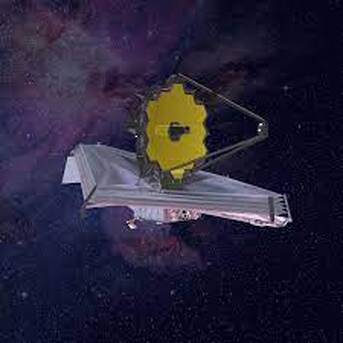
The largest, most expensive and certainly most sophisticated space telescope ever built is scheduled to lift off Saturday from the north coast of South America. Upon reaching its orbital station some 932,000 miles from Earth, the massive James Webb Space Telescope just might be able to see the beginning of time.
More than 30 years after NASA launched the Hubble Space Telescope, its giant successor is designed to see through the most ancient mists of deep space. The farther one looks into the cosmos, the further back in time one goes.
When Webb begins work in mid-2022, it will help scientists study some of the earliest light in the universe, as well as peer more closely at planets in other galaxies.
The almost $11 billion telescope, more than two decades in the making, is a National Aeronautics and Space Administration collaboration with the European and Canadian space agencies. It's set to blast off from the European Space Agency's spaceport in French Guiana aboard an Ariane 5 rocket.
For science, the Webb telescope's ultimate promise is a greater understanding around two fundamental questions for humanity: Where did we come from and are we alone? But for NASA, it's also a huge risk, given everything that could go wrong.
The telescope is "a shining example of what we can accomplish when we dream big," NASA Administrator Bill Nelson said Tuesday at a prelaunch briefing, calling it "one of the great engineering feats for the people of this planet."
Webb will examine the infrared spectrum — thermal radiation humans can't see and which is often obscured to ground-based telescopes. While Hubble is still working from an orbit much closer to Earth (340 miles away), it collects data in the visible light spectrum. It had to be repaired after launch because of a flaw in its mirror, but has been repeatedly updated and could last another two decades.
Researchers say Webb, named for NASA's administrator during the heyday of its Mercury, Gemini and Apollo rocket programs, is crucial to a deeper understanding of the early universe and how stars and galaxies formed. New insights are expected from discoveries dating back 13.5 billion years, only a few hundred million years after the Big Bang. Webb will also be able to peer more closely at objects first uncovered by Hubble, many of which are obscured by interstellar dust and gas that the newer telescope can pierce.
One Webb target is the Andromeda galaxy, the closest to our Milky Way, which reveals far more of its nature in the infrared spectrum than in visible light. The telescope has multiple forms of spectrograph imaging to study stellar composition, and its skill set includes the observation of planets — some possibly like Earth — orbiting stars in other galaxies.
But before any of this research can happen, Webb must arrive at its destination functioning and undamaged. First, the launch itself must be successful.
Then the telescope must execute a daunting series of maneuvers, with the first 13 hours of flight including two of its most critical tasks. About 33 minutes after liftoff, Webb must deploy its solar array to begin generating power. Then about 12 hours later, the craft must initiate a course-correction rocket burn to fine-tune its trajectory.
(Christmas day launch was successful. So far so good) Harv
The largest, most expensive and certainly most sophisticated space telescope ever built is scheduled to lift off Saturday from the north coast of South America. Upon reaching its orbital station some 932,000 miles from Earth, the massive James Webb Space Telescope just might be able to see the beginning of time.
More than 30 years after NASA launched the Hubble Space Telescope, its giant successor is designed to see through the most ancient mists of deep space. The farther one looks into the cosmos, the further back in time one goes.
When Webb begins work in mid-2022, it will help scientists study some of the earliest light in the universe, as well as peer more closely at planets in other galaxies.
The almost $11 billion telescope, more than two decades in the making, is a National Aeronautics and Space Administration collaboration with the European and Canadian space agencies. It's set to blast off from the European Space Agency's spaceport in French Guiana aboard an Ariane 5 rocket.
For science, the Webb telescope's ultimate promise is a greater understanding around two fundamental questions for humanity: Where did we come from and are we alone? But for NASA, it's also a huge risk, given everything that could go wrong.
The telescope is "a shining example of what we can accomplish when we dream big," NASA Administrator Bill Nelson said Tuesday at a prelaunch briefing, calling it "one of the great engineering feats for the people of this planet."
Webb will examine the infrared spectrum — thermal radiation humans can't see and which is often obscured to ground-based telescopes. While Hubble is still working from an orbit much closer to Earth (340 miles away), it collects data in the visible light spectrum. It had to be repaired after launch because of a flaw in its mirror, but has been repeatedly updated and could last another two decades.
Researchers say Webb, named for NASA's administrator during the heyday of its Mercury, Gemini and Apollo rocket programs, is crucial to a deeper understanding of the early universe and how stars and galaxies formed. New insights are expected from discoveries dating back 13.5 billion years, only a few hundred million years after the Big Bang. Webb will also be able to peer more closely at objects first uncovered by Hubble, many of which are obscured by interstellar dust and gas that the newer telescope can pierce.
One Webb target is the Andromeda galaxy, the closest to our Milky Way, which reveals far more of its nature in the infrared spectrum than in visible light. The telescope has multiple forms of spectrograph imaging to study stellar composition, and its skill set includes the observation of planets — some possibly like Earth — orbiting stars in other galaxies.
But before any of this research can happen, Webb must arrive at its destination functioning and undamaged. First, the launch itself must be successful.
Then the telescope must execute a daunting series of maneuvers, with the first 13 hours of flight including two of its most critical tasks. About 33 minutes after liftoff, Webb must deploy its solar array to begin generating power. Then about 12 hours later, the craft must initiate a course-correction rocket burn to fine-tune its trajectory.
(Christmas day launch was successful. So far so good) Harv
 RSS Feed