
john torrison president
   
  • Club Home
  • Club Members
  • Listen with Bill
    • Bill's History
  • Turntable
    • TT History
  • The FlipSide
  • Picturesque!
  • Skips Corner
  • Gulliver's Travels
  • The Club Pub
    • Sucks News
  • Harv's Corner

The Club PUBlication  06/25/2018

6/25/2018

0 Comments

 
Picture

THE CLUB 
PUB
lication

Picture
Carol Wergin Saturday June 23, 2018
Picture
Hello Friends of the Spirit of the Rivers!

Our team is working hard to bring the Spirit of the Rivers monument to the lake shore this summer.  Excavation at the monument site across from Aurora Clinic began on June 13th.   Finishing coloration, called patination, will be applied to the bronze statues in the foundry beginning next week with delivery of the statues to the lake shore expected later in July.  

​At the same time restoration will begin of the Forget Me Not Creek which empties into Lake Michigan near the monument site.  A greater flow of water in the stream will allow more varied populations of fish to swim its waters and complement a more robust and primitive setting for the monument.  

All of this work will result in completion of the site in time for the Dedication of the Monument on Sunday, September 16th at 2:00.  The dedication will take place at the monument site, located at 4815 Memorial Drive, Two Rivers, WI.  Join us in celebration of another remarkable artistic accomplishment by R.T. Wallen! 

If you'd like to support this project engraved pavers may be purchased by downloading Paving Brick Donation Forms from the website spiritoftherivers.org or by emailing us at [email protected].   If you'd like your engraved paver installed on the monument site by the time of the dedication, please return the donation and completed form by July 10th.   

Thank you to all who have contributed funds or services or moral support to bring us to this stage in a long and very fascinating process.  Your generosity made this possible!

We hope to see you on September 16th!

With Warm Regards,

​Carol
0 Comments

The ClubPUB  06/18/2018

6/18/2018

0 Comments

 
Picture

         THE CLUB 
       PUBlication

Picture
Picture yourself living in a place like El Salvador.  The government seems to have lost control as they are unable to contain gang violence in the country.

With a young family, how do YOU protect  them.  What would you do to get your family to safety?  If the government cannot protect you is that not a reason to flee? 
Where would you go?  Apparently not the US.  Our government has now ceased to view gang violence as a reason to provide asylum.  Are we trading compassion . . . for isolation?  HARV

A Minneapolis StarTribune Article
New U.S. policy targets migrants fleeing Central American Gangs.
By ELLIOT SPAGAT and ANITA SNOW • Associated Press
 JUNE 17, 2018 — 12:40PM
    _____________________________________________________________________

TIJUANA, MEXICO – The MS-13 gang made Jose Osmin Aparicio’s life so miserable in his native El Salvador that he had no choice but to flee in the dead of night with his wife and four children, leaving behind all their belongings and paying a smuggler $8,000.

Apariclo is undeterred by a new directive from Attorney General Jeff Sessions declaring that gang and domestic violence will generally cease to be grounds for asylum. To him, it’s better to take his chances with the U.S. asylum system and stay in Mexico if his bid is denied.

“Imagine what would happen if I was deported to El Salvador,” he said Wednesday as he waited at the border to enter the U.S.

The directive announced Monday could have far-reaching consequences because of the sheer volume of people like Aparicio fleeing gang violence, which is so pervasive in Central America that merely stepping foot in the wrong neighborhood can lead to death.

The Associated Press interviewed several asylum-seekers this past week at a plaza on the border, and each of them cited gang violence as the main factor in fleeing their homelands. They planned to press on with their asylum requests in spite of the new rule.

Sessions’ decision came as the administration faced a growing backlash over immigration policies and practices that human-rights advocates view as inhumane, including separating children from parents. They leveled similar criticism over the asylum changes, which the White House says are necessary to deter illegal immigration.

“The mere fact that a country may have problems effectively policing certain crimes — such as domestic violence or gang violence — or that certain populations are more likely to be victims of crime, cannot itself establish an asylum claim,” the attorney general wrote Monday, overruling a Board of Immigration Appeals decision granting asylum to a Salvadoran woman fleeing her husband.

U.S. officials do not say how many asylum claims are for domestic or gang violence, but advocates for asylum seekers said there could be tens of thousands in the immigration court backlog alone.

Many Central Americans seeking asylum say they are fleeing from gangs known as “maras,” primarily the Mara Salvatrucha (or MS-13) and Barrio 18 groups. President Donald Trump has condemned those groups, referring to members as “animals.”

The gangs were formed by young Central Americans mostly in Los Angeles decades ago and spread to the so-called Northern Triangle countries of Guatemala, El Salvador and Honduras when members were deported. Today, Honduras and El Salvador, in particular, routinely post some of the world’s highest homicide rates.

In Central America, maras stake out and battle over turf, attacking anyone who unwittingly crosses through their area on the way to school or work as a possible rival.

Gangsters sometimes forcibly take over people’s homes. They extort bus drivers and small business owners, killing those unable or unwilling to pay. They threaten teens and young men in attempts to recruit them, and force girls and young women to be their girlfriends.

Maureen Meyer, director of Mexican and migrant rights at the Washington Office on Latin America, said the ruling would "make it very difficult for a lot of the people seeking asylum in the United States."

Meyer said Central Americans commonly request asylum for extortion, forced recruitment and violence against women.  Where the gangs are prevalent moving elsewhere is not an option she said. 

"People feel very insecure in their homes and continue to see the U.S. as a safe haven in spite of Trump's anti-immigrant rhetoric,"  Meyer said of the steady northbound flow of Central Americans that began in 2014.  


0 Comments

The ClubPUB  06/11/2018

6/11/2018

0 Comments

 
Picture

The Club
PUBlication

Picture
This might not be exciting for all our Club Members but for some it just might be "riveting" !  I'll let you guess for who.

For the rest of us it's interesting reading.  If we can ship booze home after a visit I'm sure it won't be long before we can order on line!  Harv


             A Minneapolis StarTribune Article
        Sip and ship: Tourists can now send distillery whiskey home
            By BRUCE SCHREINER  Associated Press
      ​      JUNE 1, 2018 — 12:40PM
                _________________________________________________________________________________________
LOUISVILLE, Ky. — Until recently, whiskey tourists in Kentucky had been allowed to sniff the aromas of bourbon-making and sip the finished product during distillery tours. But they couldn't legally ship bottles home.

That modern-day prohibition came to an end earlier this year but was officially celebrated on Friday, when Gov. Matt Bevin and other state officials presided over the ceremonial first shipments.

Kentucky produces about 95 percent of the world's bourbon, and tourism targeting the spirit has become big business. The ability to ship whiskey bottles home after a tour is expected to boost sales at distilleries both large and small.

Industry leaders see it as a part of the experience. Many bourbon fans catch flights into the region and visit distilleries to experience a slice of Kentucky culture.

"Most all of them want to ship their bottles home as a matter of convenience versus lugging them back," said Rob Samuels, chief operating officer at Maker's Mark.

Each year, tourists make more than a million stops at distilleries along the Kentucky Bourbon Trail — which includes Jim Beam, Wild Turkey, Woodford Reserve and other venerable distilleries — and the Kentucky Bourbon Trail Craft Tour, which showcases up-and-coming micro-distilleries.

A common question during tours is: "Can I ship bottles home?" Until the recently enacted law took effect, the answer was "no."

"We have so many people that want bottles shipped, and it's been very distressing to our visitors when we have had to say, 'Oops, sorry we can't ship 'em," said Peg Hays, president of Casey Jones Distillery at Hopkinsville, near the Tennessee border.

Bevin signed the law in April, but regulators and distillery operators have needed some time to work out the details before it could be put into practice. Distillers hope that shipments will officially start making their way to customers soon.

While bottle shipments are expected to boost sales across the board, small distillers could be the biggest beneficiaries, said Hays, whose distillery is known for its moonshine whiskies.

The shipments will allow the newcomers to reach new markets, she said.

"We don't have the huge distribution that the big guys do," Hays said in a phone interview. "It's very difficult as a small, craft distillery to get ... a distributor to even look at you. This would help overcome that economic disparity when we can ship."

But for now, there are limits to where Kentucky whiskey can be shipped.

Visitors can only ship bottles if the destination state allows alcohol shipments and the location isn't in dry territory, said Eric Gregory, president of the Kentucky Distillers' Association.

Besides Kentucky, seven other states plus the District of Columbia accept shipped spirits, Gregory said. Those states are Arizona, Hawaii, Nebraska, Nevada, New Hampshire, North Dakota and Rhode Island, he said.

Under Kentucky's law, distillery sales for shipment must be made in person. Each visitor can ship up to 4.5 liters of spirits — which is six standard-sized bottles — per day. Taxes are paid on all transactions. Shippers such as UPS can transport the alcohol, provided they have proper licenses.

The law also allows bourbon fans to sign up for "Clubs of the Month" that distilleries can sponsor, enabling people to receive shipments of Kentucky spirits throughout the year.
​

Kentucky distillers hope the state's new shipping law will spread to other states. Gregory said officials in a number of states have expressed interest.   ***
0 Comments

The ClubPUB  06/04/2018

6/4/2018

0 Comments

 
Picture
Picture
The West is experiencing a period of exceptional drought.  How long it will last is anybody's guess.  Projections are for it to continue and become worse as time passes.  What to do?  Here are some ideas being considered.
Harv
                            Reprinted from Minneapolis StarTribune - Article dated May 25, 2018
​
The great siphoning:
​Drought-stricken areas eye the Great Lakes"Water, water everywhere" is the egalitarian vision of those who don't have enough of it and would like to tap the Great Lakes to get it. 
By Ron Way
Picture
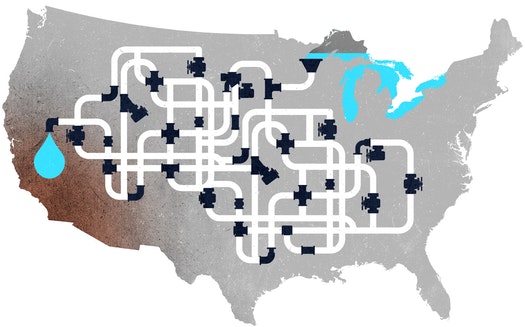
Illustration by Rob Dobi for the Star Tribune

Outside Two Harbors, Minn., on a cliff overlooking the broad expanse of Lake Superior, you are overwhelmed by grandeur — shimmering water, crashing waves, a down-bound ore boat on the horizon, miniaturized by distance.

As you fill your senses, you may be unaware of the invisible others behind you — 2,000 miles or so behind you, to the southwest — eyeing the Great Lakes in another spirit, coveting all that water.

Lake Superior is big, all right. It and the other Great Lakes contain one-fifth of the whole world’s fresh water and, get this, hold enough to submerge the continental U.S. under 10 feet.

Those far-off onlookers thirst mightily for the Lakes’ 6.5 million billion gallons of fresh water that, to them, just sits there before running off to the ocean. Wasted.

It’s easy for us lake-landers to dismiss such thoughts, but those in the American Southwest are up against a 17-year drought that keeps getting worse. After an unusually warm winter, it’s expected to worsen still more this summer due to a dearth of mountain snow that will again leave Colorado River flow far below normal, with forecasts of dry and very hot weather à la La Niña.

What’s beyond scary is that NASA computer models indicate that the West could be facing a 50-year megadrought, the first such event since long before Europeans even knew North America existed. Moreover, higher temperatures and wind wrought by climate change dry things out and increase demand for irrigation water while at the same time increasing already problematic evaporation rates from reservoirs and canals.

Primary water sources in Arizona, Nevada and Southern California are dangerously low. Benchmarks are the historically low Lake Mead reservoir behind Hoover Dam (built in 1930) and similar low levels of Lake Powell on the upstream end of the Grand Canyon. Las Vegas, which draws 90 percent of its water from Lake Mead, has twice lowered its intake “straw” due to falling levels.

One relief option is desalination of ocean water, but scaling up that technology has proved frustratingly difficult and outrageously expensive. The largest existing plant, at San Diego, provides only 7 percent of that city’s needs.

Another option is to strictly restrict water use, but that’s politically dicey and can’t get much beyond talk.

Then there’s a plan to spend gazillions to capture several of Alaska’s free-flowing rivers with a grand network of dams, canals and tunnels to divert water south to the Colorado basin. It seems that the drought is getting serious enough so that even far-fetched ideas get a look.

So OK, now what?

To desert dwellers, an idea that makes intuitive sense is to pipe Lake Superior water to where it’s “needed.” Such a project would be staggeringly expensive but technically doable; besides, the Great Lakes surely wouldn’t miss, say, 50 billion gallons — would they?

The populace all around the Lakes is rock-solid against shipping any water anywhere, and advancing any diversion plan would set off political warfare.

Or perhaps one should say “renew hostilities.” This story isn’t new. In 2007, New Mexico’s then-Gov. Bill Richardson suggested a Great Lakes diversion when the Western drought was only six years old. Following bloodcurdling protest, fellow Democrat Jennifer Granholm, then Michigan’s governor, told Richardson to zip it. A year later the eight Lakes states, including Minnesota, adopted — and President George W. Bush signed — a compact banning diversions without concurrence of all signatories.  

​
Plus, an international pact gives Canada (along with the federal government in D.C.) a veto over any transfer.

But because the ultimate power rests with Congress and the president, multistate compacts and international accords can be false security. What’s done can be undone, as evidenced by all the undoing from today’s Washington crowd. What’s more, some scholars say the compact could be vulnerable to legal challenge, especially if a national emergency were declared.

A political knockdown would pit the Midwest vs. Westerners accustomed to no-holds-barred combat for water (to the death in the Wild West) and who have tended, when all else failed, to get what they wanted by simply taking it (for example, the lands of indigenous tribes).

The West sees some things in its favor, politically. One is mushrooming population that’s tipping the power balance in Congress. Another is the always-powerful agriculture industry in the West. And still another is that Western states stick together like fired clay to leverage their will over all things land and water. Besides, they’ll argue, water is a resource that, like oil, must be shared.

And so, a prediction: Within the lifetime of today’s newborn, Great Lakes water will be piped to the Colorado basin to relieve a region that by midcentury will be in the throes of an unimaginable water crisis.

This notion was advocated last year by NASA’s chief water scientist at California’s Jet Propulsion Laboratory, who added that national water shortages are more serious than most realize — and may be unsolvable.

On several levels, it’s frankly absurd to pipe water across the country to bail out overbuilt cities and nourish water-intensive crops in bone-bleaching desert. But growth-driven Westerners dismiss such talk. This war would come down to raw power politics, and it’s only a matter of time before the West’s political influence prevails.

Consider: Less than 80 years ago, North Dakota had more electoral votes than Arizona, and Phoenix was a remote outpost. Today, Arizona has more people than North Dakota, South Dakota and Minnesota combined. That kind of growth is evident throughout the Southwest, which means more and more members of Congress are being sent by dry states rather than by the water-rich Midwest.

It’s not realistic to think that pioneers more than a century ago could have foreseen today’s mess. Western settlement was blindly driven by Manifest Destiny back then, and land and water were both considered limitless.

Today, the West’s chief water user is agriculture, with three-fourths consumed by water-gulping crops like cotton, citrus, alfalfa and vegetables. Irrigated fields around hot, dry Yuma, Ariz., produce so many winter vegetables that nearly all of your salad comes from Yuma. Irrigated fields grow countless tons of alfalfa to feed livestock, crowded into giant feedlots nearby.

So much water is sucked from the Colorado to grow crops and quench thirsts that the river’s flow into Mexico is a relative trickle.  

The Southwest’s water crisis is a result of dubious policy that pushed unsustainable growth, incented by federally financed dams, reservoirs and canals that delivered water at astonishingly low cost to cities and farmers.

Requirements that states and users repay the cost of building waterworks are often waived with little notice. Just one of these giant projects, the 336-mile concrete canal moving Colorado River water to Phoenix and Tucson, cost $4 billion to build in the 1970s ($26 billion today) and many millions to maintain. Relatively little has been repaid to taxpayers, or ever will be.

Another problem is that governments allocated Colorado River water based on 1920s projections, when river flows were abnormally high. When more reliable tree-ring analyses later exposed major distortions in projections, the West went into collective denial and did little to rein in explosive growth.

So, why should Great Lakes water be shipped to a desert where unrestrained growth continues? It shouldn’t be, but debating this one will get you into a sticky wicket of the outsized influence of infrastructure (water works, roads, bridges, wetland drainage, etc.) in too often enabling inefficient and harmful growth. Genuflection to development has skewed urban and rural planning since long before the country’s founding.

Diverting water west would require a 900-mile pipeline from Duluth to, most likely, Green River, Wyo. There, the river flows south into Utah and joins the Colorado near Moab.

It would be a colossal technical and financial undertaking.

Lifting, say, 50 billion gallons of water from Duluth by 5,500 vertical feet over the Continental Divide to Green River would consume the power of several hundred plants the size of Xcel Energy’s nuclear generator at Monticello.

The power sources would cost tens of billions to build and operate, on top of which would be billions more to install and maintain the pipeline.

And while 50 billion gallons sounds like a lot of water, it would take 10 times that amount to dent the Southwest drought.

These are dizzying numbers, but it’s a straightforward bargain plan compared with capturing and moving water south from Alaska.  

Either way, taxpayers would surely get stuck with the tab — as the West keeps building cities and growing crops in bone-dry desert.

Ron Way lives in Edina.

0 Comments

    Archives

    December 2025
    November 2025
    October 2025
    September 2025
    August 2025
    July 2025
    June 2025
    May 2025
    April 2025
    March 2025
    February 2025
    January 2025
    December 2024
    November 2024
    October 2024
    September 2024
    August 2024
    July 2024
    June 2024
    April 2024
    March 2024
    February 2024
    January 2024
    December 2023
    November 2023
    October 2023
    September 2023
    August 2023
    July 2023
    June 2023
    May 2023
    April 2023
    March 2023
    February 2023
    January 2023
    December 2022
    November 2022
    October 2022
    September 2022
    August 2022
    July 2022
    June 2022
    May 2022
    April 2022
    March 2022
    February 2022
    January 2022
    December 2021
    November 2021
    October 2021
    September 2021
    August 2021
    July 2021
    June 2021
    May 2021
    April 2021
    March 2021
    February 2021
    January 2021
    December 2020
    November 2020
    October 2020
    September 2020
    August 2020
    July 2020
    June 2020
    May 2020
    April 2020
    March 2020
    February 2020
    January 2020
    December 2019
    November 2019
    October 2019
    September 2019
    August 2019
    July 2019
    June 2019
    May 2019
    April 2019
    February 2019
    January 2019
    December 2018
    November 2018
    October 2018
    September 2018
    August 2018
    July 2018
    June 2018
    May 2018
    April 2018

    RSS Feed