CLIMATE CHANGE
&
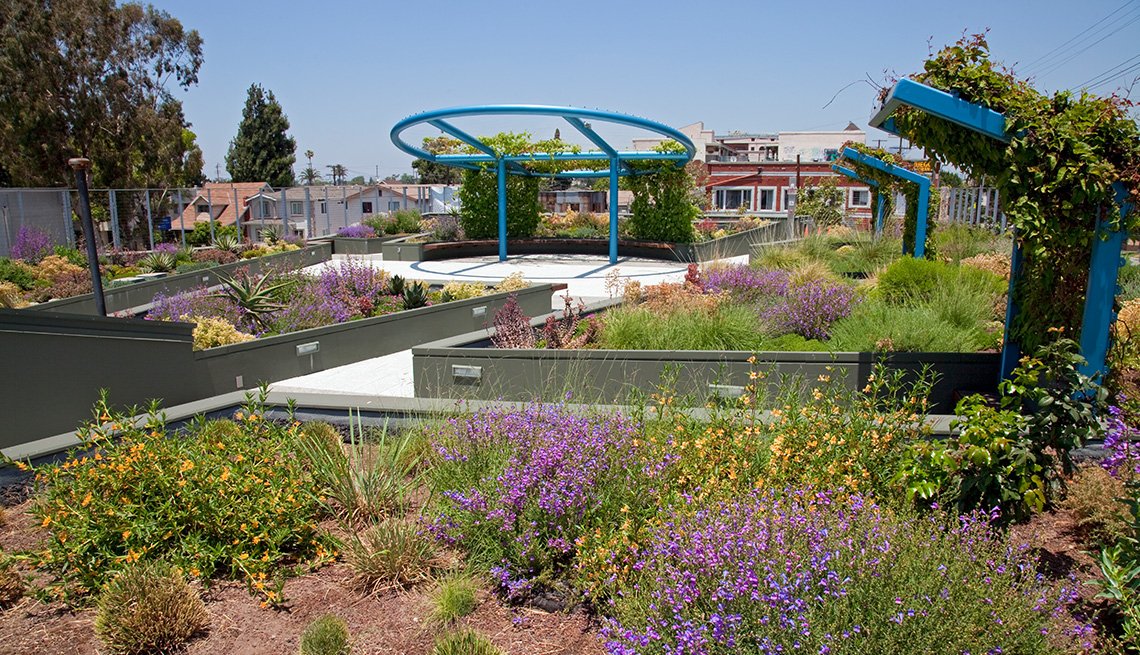
CITIZENS OF THE PLANET/EDUCATION IMAGES/UNIVERSAL IMAGES GROUP VIA GETTY IMAGES Drought tolerant green roof garden in Los Angeles incorporates many sustainable features into its design and is a Leed certified building.
 |  |
Your lifestyle
Risk: Changing seasonal climates
Impact: Tougher gardening conditions
For decades, gardeners have relied on the U.S. Department of Agriculture's (USDA) plant hardiness maps to know which species can survive the winter in their region. But in 2012, the agency updated its maps to reflect a warmer world. The new map generally showed a 5-degree change in the average minimum winter temperatures across much of the country. While a longer growing season helps some — gardeners who historically were unable to grow heat-loving crops, such as watermelon and oranges, sometimes now can — the change also presents challenges.
Higher summer temperatures affect the productivity of many flowers and vegetables, while other crops need a certain number of winter chill units — measured as the number of hours between 32 and 45 degrees — to produce blossoms or fruit.
A changing climate also alters the geographic distribution of garden pests. Patty Glick, author of The Gardener's Guide to Global Warming: Challenges and Solutions, once grew bountiful roses in Seattle, but that changed when aphids moved into her garden. “I decided I wasn't going to grow roses anymore because I didn't want to spray,” she says.
The good news, says Glick, is that strategies to adapt gardens to climate change often help in other ways. A thick bed of mulch helps hold moisture in drought-stricken beds while preventing erosion in downpours — increasingly common extremes. It also adds organic matter to the soil, which simultaneously improves fertility and sequesters carbon.
Risk: Hotter weather and rising sea levels
Impact: Lost travel opportunities
Time to edit our bucket lists? Destinations we long had on our “someday” travel lists — the Great Barrier Reef, Alaska's ice fields, the Taj Mahal, Antarctica — are endangered by warming temperatures, pollutants and rising seas. In 2019, Venice, Italy, experienced its highest tides in more than 50 years. At Everglades National Park, mangrove trees have been growing farther inland as the amount of freshwater marsh has been shrinking while sea levels rise. Even New York City's Lady Liberty is sweating it out. Relentless storm surges during Hurricane Sandy in 2012 left Liberty Island and nearby Ellis Island with more than $77 million in weather-related damage.
Over the past 150 years, the soft chalk that makes up the famous White Cliffs of Dover in England has been eroding 10 times faster than in the previous 7,000 years. When it was established in 1910, Montana's Glacier National Park had nearly 150 active glaciers. Now there are only about 25.
"Even if we don't notice these losses as travelers today,” says Nicole Sintov, assistant professor of behavior, decision-making and sustainability at Ohio State University's School of Environment and Natural Resources, “our grandchildren certainly will.”
Impact: Lost travel opportunities
Time to edit our bucket lists? Destinations we long had on our “someday” travel lists — the Great Barrier Reef, Alaska's ice fields, the Taj Mahal, Antarctica — are endangered by warming temperatures, pollutants and rising seas. In 2019, Venice, Italy, experienced its highest tides in more than 50 years. At Everglades National Park, mangrove trees have been growing farther inland as the amount of freshwater marsh has been shrinking while sea levels rise. Even New York City's Lady Liberty is sweating it out. Relentless storm surges during Hurricane Sandy in 2012 left Liberty Island and nearby Ellis Island with more than $77 million in weather-related damage.
Over the past 150 years, the soft chalk that makes up the famous White Cliffs of Dover in England has been eroding 10 times faster than in the previous 7,000 years. When it was established in 1910, Montana's Glacier National Park had nearly 150 active glaciers. Now there are only about 25.
"Even if we don't notice these losses as travelers today,” says Nicole Sintov, assistant professor of behavior, decision-making and sustainability at Ohio State University's School of Environment and Natural Resources, “our grandchildren certainly will.”
Risk: Heat and poor air quality
Impact: Becoming housebound
Beyond the risk to your health, climate change can affect your fitness and social life. Those who do the responsible thing and heed warnings to stay indoors on days with a high heat index or poor air quality are nonetheless missing out on regular walks, rounds of golf with friends and fishing trips with the grandkids. And it isn't even just the heat that's at play. “Any change in climate that affects weather will affect the older population most directly and keep people housebound,” says Casey J. Wichman, an environmental economist at the Georgia Institute of Technology
It's clear, too, that we are making our homes more comfortable. In Northeastern states, only about 50 percent of all new homes were built with central air-conditioning in 1975. By 2015, that figure exceeded 90 percent.
But this is one area of climate change that may not be all bad news. While summers are getting hotter, the flip side is that winters and shoulder seasons are milder, and that means more opportunities for cycling, hiking, fishing, camping and other outdoor pursuits on days between 60 and 70 degrees.
Impact: Becoming housebound
Beyond the risk to your health, climate change can affect your fitness and social life. Those who do the responsible thing and heed warnings to stay indoors on days with a high heat index or poor air quality are nonetheless missing out on regular walks, rounds of golf with friends and fishing trips with the grandkids. And it isn't even just the heat that's at play. “Any change in climate that affects weather will affect the older population most directly and keep people housebound,” says Casey J. Wichman, an environmental economist at the Georgia Institute of Technology
It's clear, too, that we are making our homes more comfortable. In Northeastern states, only about 50 percent of all new homes were built with central air-conditioning in 1975. By 2015, that figure exceeded 90 percent.
But this is one area of climate change that may not be all bad news. While summers are getting hotter, the flip side is that winters and shoulder seasons are milder, and that means more opportunities for cycling, hiking, fishing, camping and other outdoor pursuits on days between 60 and 70 degrees.
Risk: Shifting seasonal climates
Impact: Birding flies away
The American robin once returned from wintering in Florida and Mexico as a harbinger of spring across the continental U.S. Now robins are spotted as far north as Alaska and New England all winter long. “People think of climate change as a future problem, but birds are the great messengers that these changes are happening now,” says Brooke Bateman, director of climate science for the National Audubon Society.
Older Americans who are interested in bird-watching don't need binoculars to see the problems. Two-thirds of America's birds are threatened with extinction from climate change, which puts 389 of our 604 bird species on the brink — a finding Audubon calls “the fifth alarm in a five-alarm fire."
Impact: Birding flies away
The American robin once returned from wintering in Florida and Mexico as a harbinger of spring across the continental U.S. Now robins are spotted as far north as Alaska and New England all winter long. “People think of climate change as a future problem, but birds are the great messengers that these changes are happening now,” says Brooke Bateman, director of climate science for the National Audubon Society.
Older Americans who are interested in bird-watching don't need binoculars to see the problems. Two-thirds of America's birds are threatened with extinction from climate change, which puts 389 of our 604 bird species on the brink — a finding Audubon calls “the fifth alarm in a five-alarm fire."
 RSS Feed